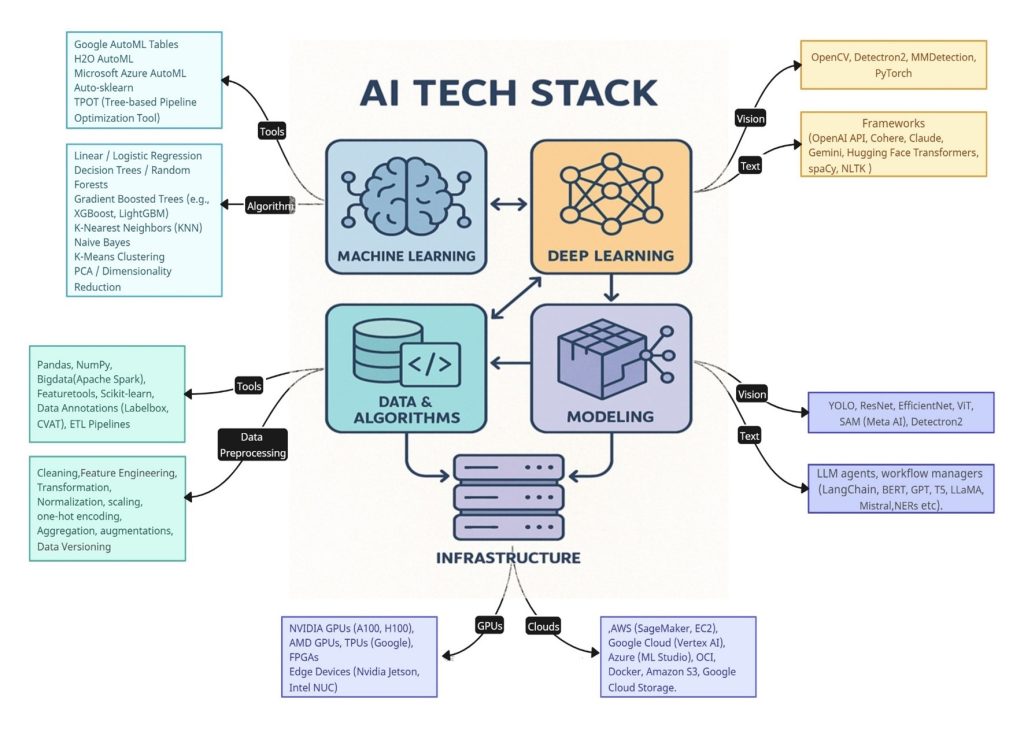
In today’s AI-driven world, choosing the right tools and frameworks isn’t just a preference — it’s the difference between building something smart and building something that truly works. Whether you’re deploying a computer vision system, building a recommendation engine, or launching an LLM-powered agent, a well-structured AI tech stack is essential.
The AI stack is a structural framework comprising interdependent layers, each serving a critical function to ensure the system’s efficiency and effectiveness. AI stack’s layered approach allows for modularity, scalability, and easy troubleshooting. Artificial Intelligence isn’t powered by a single technology or tool—it’s an ecosystem. Just like modern software runs on stacks of interconnected tools, AI development follows a layered architecture known as the AI tech stack.
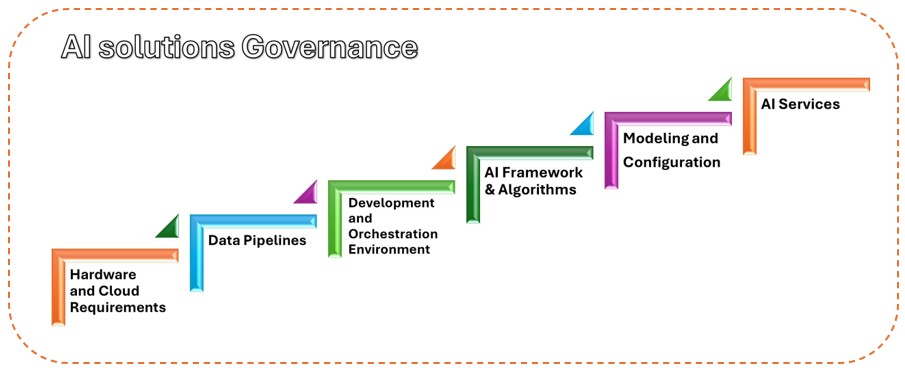
Robust governance isn’t the final step in the process; it’s the foundation upon which the entire AI stack is built. It’s a framework of principles that ensures every decision, from data collection to model deployment, is made responsibly. For us, this is a moral and ethical obligation that defines how we build technology. Our governance model stands on three core pillars:
Based on this Governance Model, underlines the SIX- LAYERED Architecture for AI Solution development.
This matches the scholarly emphasis on compute scalability and telemetry. For instance, IBM’s hybrid AI architecture, underscores the synergy between specialized chips, cloud telemetry, and performance profiling.
Effective AI relies on robust data pipelines: ingestion, annotation, cleaning, features, transformation, lineages, governance.
Advanced patterns like data mesh—decentralizing pipeline responsibility across domain-aligned teams—are gaining attention in engineering research for improved scalability and collaboration.
This layer is the central workbench and control tower for your entire AI lifecycle. It’s an integrated environment that sits on top of the Hardware and Cloud Foundation, providing data scientists and ML engineers with the tools they need to build, train, deploy, and manage models systematically.
The “AI framework” layer houses libraries such as TensorFlow, PyTorch, and Scikit-learn. These follow toolbox design patterns, where components support diverse workflows—from preprocessing to model optimization. Such patterns were analyzed in depth in arXiv’s study on ML toolbox design.
Architectures like ResNet, Vision Transformer, YOLO, U-Net, and SAM reflect task-specific structure and parametric tuning.
Transformer-based models (BERT, GPT, T5, LLaMA, Mistral) are foundational.
Attention Is All You Need,” a landmark paper introducing Transformer models, remains one of the most cited works in the past decade.
Multi-agent workflows (e.g., LangChain, AutoGen) are being formulated into higher-order patterns that embed reasoning steps into orchestration pipelines.
These include LLM-powered APIs, chatbots, vision services, and multi-agent orchestrators. Business-focused analyses demonstrate a trend towards identifying observation and orchestration layers in enterprise AI—distinguishing core inference from prompt/tool chaining and monitoring.
AI frameworks serve as the mid-layer glue between infrastructure (hardware/accelerators) and higher-level model development. They abstract tensor operations, gradient flows, and model definitions—allowing researchers and developers to focus on experimentation and deployment.
The three most widely adopted frameworks are PyTorch, TensorFlow, and Keras.
AI solution is a carefully designed tech stack — a set of tools and practices that keep everything running smoothly, here’s how we design AI systems we trust :
AI learns from data — the better the data, the better the results.
Like teaching a child by showing thousands of examples — but being very careful to store and remember every lesson properly.
This is where the AI learns to “see,” “understand,” or “predict” things from data.
Like training a dog to recognize voices or gestures — you try, reward, and refine until it performs well.
Before AI is trusted in the real world, it needs to pass the test — not just once, but every time.
Like crash-testing a car before it hits the road — safety comes from preparation, not hope.
AI shouldn’t just react to the moment — it should recognize trends, adapt, and keep improving.
Like a veteran aircraft mechanic who not only performs routine maintenance — but can tell from a slight change in the engine’s hum.
The same AI should work on a single camera or across an entire city.
Like designing a power bank that works across every phone, not just one.
A great AI system isn’t just a smart algorithm — it’s an ecosystem built for clarity, reliability, and trust. Every part of our tech stack — from data and models to deployment and monitoring — is designed with human-level accountability in mind.
We call it the AI Stack We Trust, because it delivers what matters most: clarity, performance, and peace of mind — whether you’re building on the cloud or deploying AI at the edge.
“AI should never be just smart — it should be responsible.”