If you’ve landed on this blog, chances are you’ve either read our previous post on data annotation or you’re looking for the most efficient way to train a custom object detection model. Either way, you’re in the right place.
Object detection has seen significant advancements, and multiple models perform well for this task. Some popular ones include:
However, in this blog, we focus on YOLO (You Only Look Once) because it is fast, easy to use, and offers a great balance between accuracy and inference speed.
YOLO is one of the most efficient object detection models due to the following characteristics:
Before jumping into training, it is important to determine which YOLO variant best suits your needs. Different versions of YOLO offer trade-offs between speed and accuracy:
For more on preparing your data environments for AI, refer to our blog on AI Readiness.
Your dataset quality directly impacts model performance. Here’s how to set it up efficiently:
These are some major augmentations increase variability in training data and help improve model generalization.
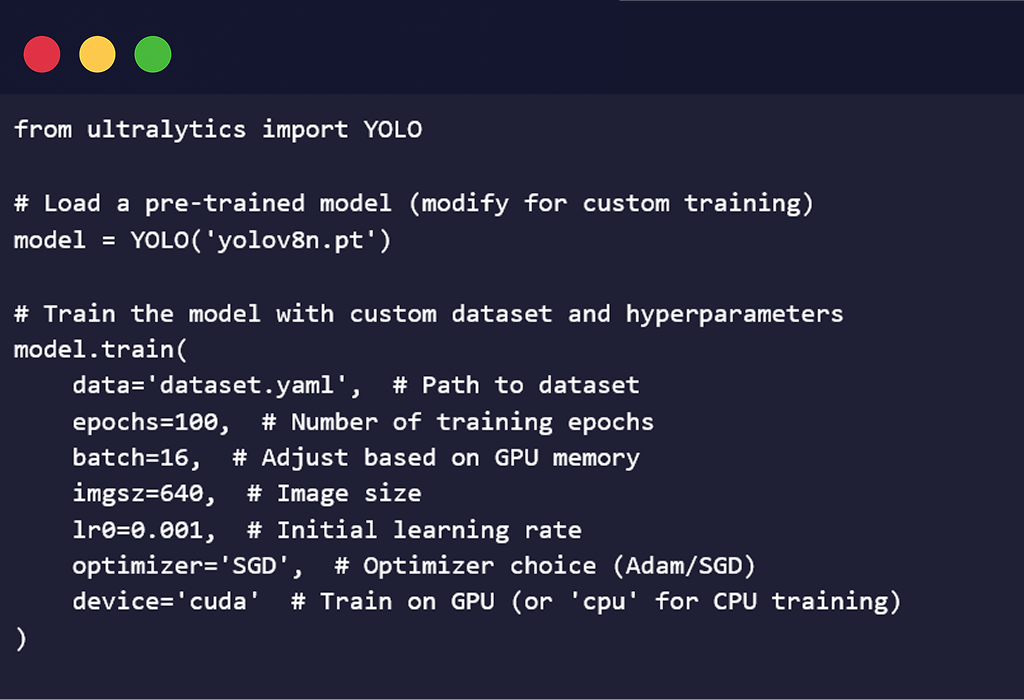
Tuning the right hyperparameters is key to getting the best results. Here are a few essential ones:
Training a YOLO model efficiently also depends on your hardware setup. Here are some key factors:
To ensure optimal results, avoid these common mistakes:
While several object detection models exist, YOLO remains a top choice due to its speed, efficiency, and ease of deployment. Training a YOLO model efficiently requires a strategic approach—from selecting the right variant, setting up a high-quality dataset, tuning hyperparameters, and choosing the right infrastructure. By following these best practices, you can build an accurate and robust object detection model tailored to your specific needs.